All dishes / 中東・北アフリカ
Kunafa Period BOrigin theory CVerified
Some fields (dish name, region and gates) are shown from the Japanese-edition data.
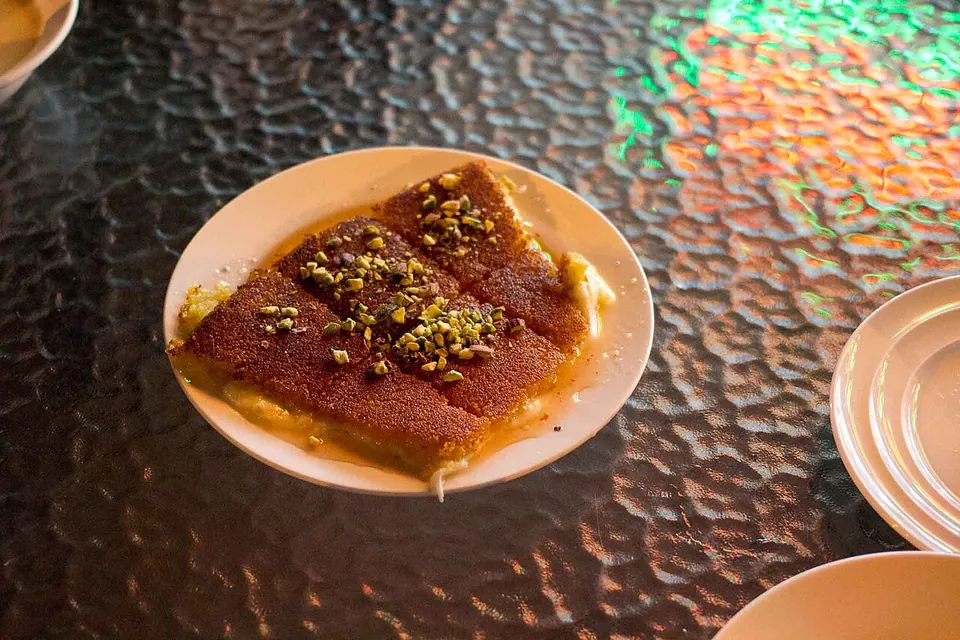
A beloved Middle Eastern sweet: molten white cheese layered with pastry and drenched in syrup. It looks like a dessert handed down unchanged from the Middle Ages, yet the cheese-filled version we eat today first appears in writing only in the nineteenth century—and not in Nablus, the city famed as its birthplace, but in a cookbook from Beirut.
Verification highlight popular claim → verdict → evidence
Popular claim: kunafa nabulsiyya (cheese-layer kunafa) originated in Nablus. Verdict: refuted as a single-city invention claim — the earliest attested cheese-layer kunafa is a Beirut cookbook of 1885 (Khalil Khattar Sarkis), while Nablus's link to the dish appears only from 1923 onward, so the timing does not fit; Nablus's fame for its own style is still real. Key sources: Mary Işın, Sherbet and Spice; Wikipedia (Knafeh) citing Işın/Newman; Making Levantine Cuisine (Univ. of Texas Press).
The three gates
- Ingredient-supply gate
- Wheat and cheese are native staples; sugar spread early across the Islamic world.
- Cooking-technique gate
- The limiting factor is technique: layering white cheese over kadaif/semolina dough and baking it. Cheese-layered kunafa is unattested before the 19th century, which bounds the current form (medieval kunafa was a different, thin pan-baked dough closer to qatayef).
- Venue gate
- Urban confectioners; a street and festival sweet, made by artisans in city communities.
Overview
When and where it took shape
Knafeh is a sweet in which a layer of white cheese is enclosed in thin, thread-like or semolina pastry, baked, and then soaked while hot in sugar syrup. The version from the Palestinian city of Nablus is especially well known as a style (knafeh nabulsiyya) that uses the local salty white cheese.
Wheat and cheese were both long-established in this land, and sugar had spread through everyday sweets across the Islamic world from early on. With such ingredients at hand, the moment a particular method emerged—layering white cheese into thin pastry, baking it, and finishing it with hot syrup—knafeh in its present form came into being.
This cheese-layered method appears in writing only in the nineteenth century. The oldest surviving example is a cookbook printed in Beirut in 1885, Tadhkirat al-Khawatin wa-Ustadh al-Tabbakhin, by Khalil Khattar Sarkis; it gives four knafeh recipes, including a cheese-filled one. As city confectioners plied their craft and served the sweet in the streets as a festival treat, it spread through people's lives.
How we know
A sweet called knafeh has existed for a very long time. The thirteenth-century cookbook Kitab al-tabikh fi-l-Maghrib wa-l-Andalus describes knafeh as a pancake baked in a flat pan, thinner than qatayif, and passes down a recipe in which fresh cheese is layered onto the thin dough, baked, and topped with honey and rose-water syrup. In Mamluk-era Damascus, Ibn al-Jazari recorded overseeing the quality of knafeh and qatayif as Ramadan sweets. The name knafeh does reach back into the medieval Islamic world.
But that medieval knafeh was a thin dough baked in a flat pan, a different thing from today's form with its thread-like pastry and layer of white cheese. An intermediate stage has also come to light. In 1844, Jakob Berggren's dictionary of the colloquial Arabic of Syria and Egypt records a knafeh made with string dough and reduced cream (qaymaq). This stood between the medieval flat-pan pancake and the nineteenth-century white-cheese layer—a dairy-bearing knafeh at a midpoint. The food historian Mary Işın, who has written a history of Turkish sweets, notes that cheese-filled knafeh does not appear in records before the nineteenth century, and places the emergence of today's cheese-layered form in that century.
One more thing needs retelling: the famous story of a Nablus origin. The establishment of the Nablus style and its renown are matters of fact, but the oldest surviving example of cheese-layered knafeh is in Beirut (1885), not Nablus, and the clear link to Nablus appears in writing only later, from 1923 (Khalil Totah) onward. In other words, no contemporary record yet found lets us say plainly that today's form of knafeh was born in Nablus. A medieval name, the present form fixed in the nineteenth century, and the gap between renown and record over the birthplace—keeping these three apart is the key to tracing this sweet's history correctly.
The full set of origin theories and the detailed verification log — traceable all the way to their sources — are available on the Japanese edition.
See the full origin theories and verification log (Japanese) →