All dishes / 西欧
Ajillo (gambas al ajillo) Period COrigin theory CVerified
Some fields (dish name, region and gates) are shown from the Japanese-edition data.
Gambas al ajillo, a dish unique to sixteenth-century Madrid: you will see that billing often enough, but no source backs it up. It is an origin myth that mistakes the age of a technique for the shape of the dish we eat today.
Verification highlight popular claim → verdict → evidence
Popular claim: gambas al ajillo was invented in 16th-century Madrid. Verdict: no evidence supports a 16th-century Madrid origin. The most complete Spanish court cookbook of the era, Martinez Montino's Arte de cocina (1611), uses garlic and oil constantly but never the word "ajillo," and never mentions shrimp at all. The technique of cooking garlic gently in oil does have a genuinely older layer, tracing back to Moorish cooking in al-Andalus -- but the specific shrimp-in-garlic-oil tapa only shows up in documented shop history at a Madrid bar, La Casa del Abuelo, which added shrimp dishes after the 1940s, centuries after the claimed 16th-century date.
The three gates
- Ingredient-supply gate
- Both garlic and olive oil are native to Iberia/the Mediterranean (since antiquity/the medieval period). No limiting ingredient applies, so the ingredient gate is perpetually satisfied with no contradiction.
- Cooking-technique gate
- The al ajillo technique of gently cooking garlic in olive oil over low heat. Its underlying layer traces back to oil-and-garlic cooking of North African/Middle Eastern origin from al-Andalus (Islamic-era Iberia, 711-1492).
- Venue gate
- urban bars and taverns (small tapas plates). Social common people. everyday. urban diners eating out.
Overview
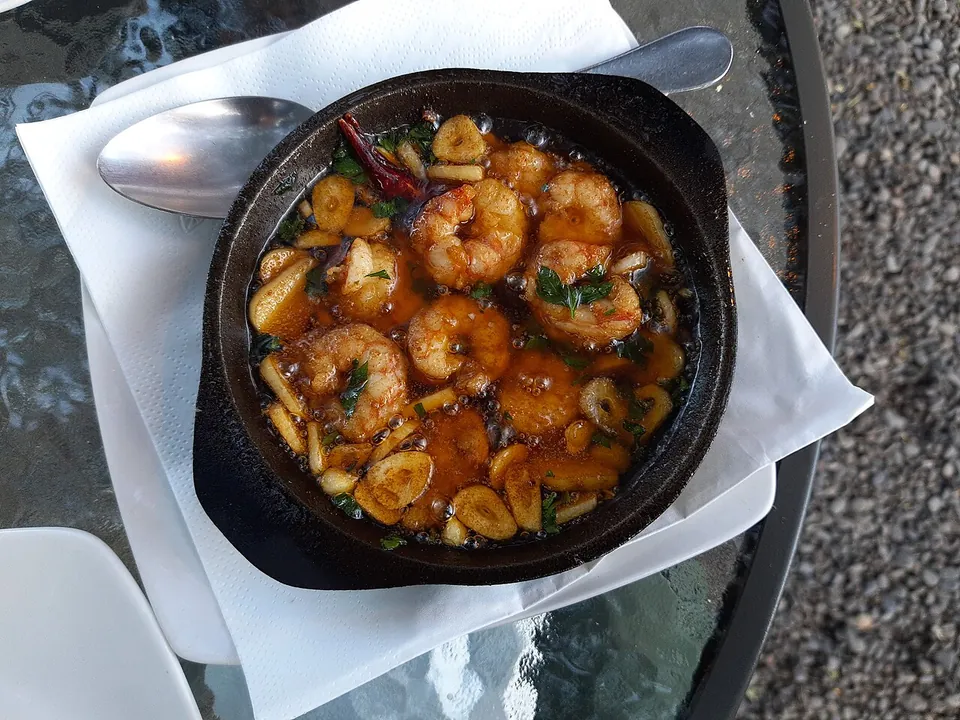
Ajillo is a Spanish small plate of chopped garlic gently cooked in plenty of olive oil, with shrimp or other morsels added. The Spanish phrase al ajillo means "in garlic," a way of describing how something is cooked, not the name of a dish invented by any one person. It is a common turn of phrase built from ajo (garlic) plus a diminutive, and the historical dictionary of the Spanish Royal Academy carries no old, dedicated entry for it as a culinary term.
Garlic, the main player, and the olive oil used so freely were both ordinary local ingredients across the Iberian Peninsula and the Mediterranean coast from antiquity into the Middle Ages. They were long-established staples in the everyday kitchen, never in short supply.
The gesture itself, cooking or frying garlic in oil, goes back a long way. Food historians favor a base in the oil-and-garlic cookery of Islamic-era Iberia (al-Andalus, 711 to 1492), rooted in North African and Middle Eastern traditions. The form we now picture, though, an ajillo served in a small earthenware dish at a bar, and above all gambas al ajillo, is far more recent. As bar and tapas culture spread through the nineteenth and twentieth centuries, it took hold across Spain largely from Madrid outward. Southern Andalusia, home to fine olive oil and garlic, is also widely named as its birthplace.
How we know
Tourist media and recipe sites in the English-speaking world return again and again to a billing that calls gambas al ajillo a dish unique to sixteenth-century Madrid. No contemporary record supports it.
The unraveling follows three threads. First, the name. Al ajillo is only garlic plus a diminutive, and the historical dictionary of the Spanish Royal Academy holds no old, dedicated entry for it as a dish (the only sense it records is the plant, gladiolus). Second, the technique. The way of cooking with garlic and olive oil traces to the Islamic period of medieval Iberia, and is in no way particular to sixteenth-century Madrid; the food historian Charles Perry follows this strand of Spanish cooking back to its Moorish, al-Andalus roots. Third, the present form. The small plate of gambas al ajillo took hold in Madrid's tabernas much later, in the twentieth century and above all in the postwar 1940s. The house history of La Casa del Abuelo, a Madrid establishment founded in 1906, records introducing shrimp dishes after the war and moving from a griddle preparation toward the al ajillo style.
A fourth thread runs through the cookbooks of the very time and place the billing names. Francisco Martínez Montiño, chief cook to Philip III, brought out Arte de cocina in Madrid in 1611, and it became the standard book of seventeenth-century Spanish court cookery. Read end to end, it never once uses the word ajillo. The scan is not at fault: aceyte, the period spelling of oil, turns up ninety-nine times in it, and ajo or ajos seventy-two. Here is a book that pours oil and crushes garlic on page after page, and it gives the act of simmering garlic in oil no name of its own. Small shrimp fare worse still—camarón, gamba, and langostino appear nowhere in it, and no entry sets them out as a dish. The plate said to have been born in sixteenth-century Madrid is missing from the book that wrote down that court's kitchen.
It is not that the spelling was absent from the Spanish of the period. Juan de Altamiras, whose Nuevo arte de cocina (1745) was the most widely read practical cookbook of eighteenth-century Spain, uses it exactly once. But it comes in a recipe for squash—por mas ajillos no tendrá mas substancia, no amount of extra garlic will give it more substance—as the ordinary diminutive of ajo, not the name of a dish.
The silence holds to the close of the nineteenth century. Ángel Muro's El Practicón (Madrid, 1894), an exhaustive dictionary of Spanish cookery, has no ajillo in it either. What it does set down about small shrimp is that they are boiled in seawater and eaten cold as a starter; of langostinos it states outright that there is no preparation for them beyond boiling and chilling. A hot little dish of garlic and oil had no place yet in the scheme of Spanish cooking at the end of the nineteenth century.
Absence from cookbooks is not proof that nobody in the streets and tabernas was making it. A humble plate can take a long time to reach print. Even so, the billing of "sixteenth century" and "unique to Madrid" comes from joining the base of an old technique to a newer current form as if they were one line. Separate the two, and the seam in the origin myth comes into view.
The full set of origin theories and the detailed verification log — traceable all the way to their sources — are available on the Japanese edition.
See the full origin theories and verification log (Japanese) →