All dishes / 北米
Crab cake Period BOrigin theory CVerified
Some fields (dish name, region and gates) are shown from the Japanese-edition data.
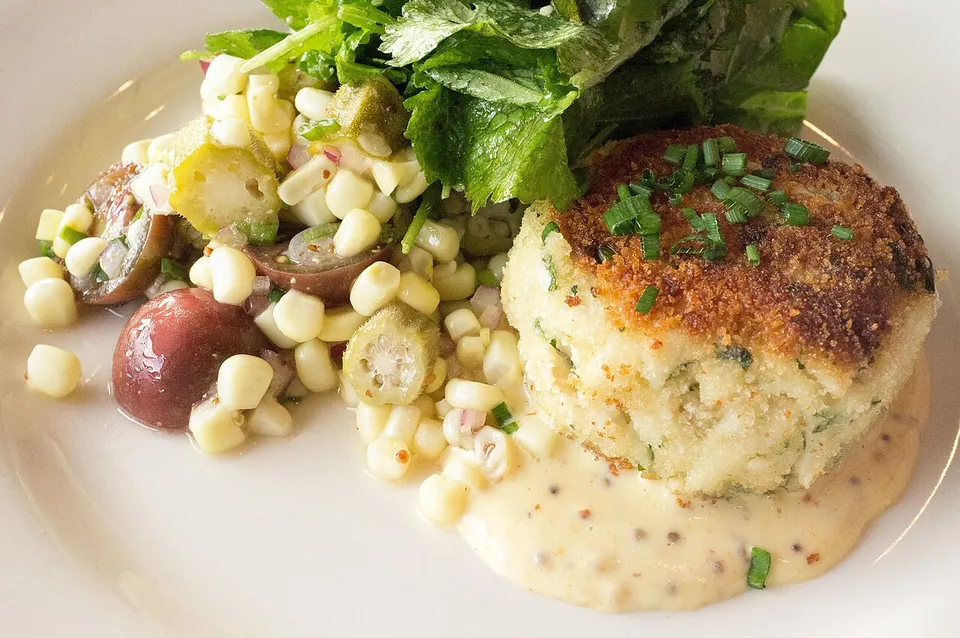
Maryland's crab cake is a regional dish of picked blue-crab meat bound with breadcrumbs or crackers and shaped into a patty. Eating crab on Chesapeake Bay reaches back to Native peoples, but the name 'crab cake' and the form we know settled only from the end of the nineteenth century onward.
Verification highlight popular claim → verdict → evidence
Myth: Crosby Gaige is often credited with inventing/naming the Baltimore/Maryland crab cake in his 1939 cookbook. Verdict: refuted -- Thomas J. Murrey's 1891 recipe in Cookery with a Chafing Dish predates Gaige by 48 years; Gaige's contribution was popularization, not invention. Main sources: Murrey, Cookery with a Chafing Dish (1891); Maryland's Way: The Hammond-Harwood House Cook Book (1963).
The three gates
- Ingredient-supply gate
- The blue crab at the heart of the dish is native to the Chesapeake Bay, and Indigenous peoples were eating it long before Europeans reached the coast. It came out of the bay itself, so the supply of the main ingredient sets no earliest date for the dish.
- Cooking-technique gate
- What defines the dish is the handwork: picking the meat out of the crab, then binding and shaping it with breadcrumbs or crackers. European settlers worked out that method, and it appears in print in the 19th century. Refrigerated rail in the 1930s carried crab cakes across the country, but the dish had already taken shape around the bay.
- Venue gate
- Home kitchens and local cooking in the coastal towns around the bay: everyday fare of ordinary households, eaten by anyone living there.
Overview
A crab cake is picked blue-crab meat, bound with breadcrumbs or crackers, shaped into a patty, and fried or broiled. It grew up as a home dish along the shores of Chesapeake Bay—Maryland above all—and came to be known widely as a Baltimore specialty.
The blue crab at its center is a creature of the bay, long native to those waters. The Powhatan and other Native peoples ate it well before Europeans arrived. It filled the shallows in numbers, an ingredient always within reach.
Onto that abundance of crab meat, European settlers laid one piece of technique. The meat was carefully picked, bound with breadcrumbs or crackers, shaped into a cake, and fried or broiled; this way of binding and forming took hold and was written down in cookbooks during the nineteenth century. From it emerged a dish that could be called a crab cake, appearing on coastal home tables. When refrigerated railcars began to run in the 1930s, the bay's crab dishes could travel to inland towns far away, and the crab cake went on to earn nationwide fame as a restaurant signature. That it took root as a regional dish across the nineteenth and twentieth centuries can be traced in print, even as the finer points of its origin remain contested.
How we know
The crab cake carries a small mix-up about when it first appeared in print—not some grand tale invented after the fact, but a popular belief that misread the dates, corrected against the record.
The long-held story was that the name 'crab cake' first reached print in 1939, in Crosby Gaige's New York World's Fair Cook Book.
Yet there is a record nearly half a century earlier. In 1891, Thomas J. Murrey's Cookery with a Chafing Dish plainly carries a method of boiling hard-shell crab meat and binding it with egg yolk into cakes. The line—'The meat from the hard shell crabs, after boiling, may be made into little cakes, held together with the yolk of an egg'—can still be read today in the full text on the Internet Archive. Gaige's 1939 book trails it by forty-eight years. The first time a dish is written down is not the moment it was born, and this earlier line makes plain that 1939 cannot be called the beginning.
The antiquity of eating crab and the newness of the present form are worth keeping apart. Eating crab on Chesapeake Bay reaches back to Native peoples. Maryland's Way (published 1963), compiled from eighteenth- and nineteenth-century Maryland manuscripts and old cookbooks, records crab-cake methods going back to the early nineteenth century—five of them—conveying how deeply the dish was rooted as a local food. But the settling of the present form, as one dish bearing the name 'crab cake,' appears late in print: late-nineteenth-century Maryland. A line is drawn between the older, general crab dishes and the named, fixed form of the crab cake.
There was also a hunt for older traces. A popular claim points to an 1873 Harrisburg newspaper carrying the words crab cakes. But that paper's run can be confirmed in the bibliography only from 1879 onward, and the 1873 page itself could not be located. The firmest earliest source remains, for now, Murrey in 1891.
The full set of origin theories and the detailed verification log — traceable all the way to their sources — are available on the Japanese edition.
See the full origin theories and verification log (Japanese) →