All dishes / 東南アジア
Pad thai Period COrigin theory CVerified
Some fields (dish name, region and gates) are shown from the Japanese-edition data.
Souvenir shops and travel writers will tell you that pad Thai is an ancient Thai dish, brought by Chinese merchants to the Ayutthaya kingdom in the eighteenth century. But the name first appears in print only in 1962, and the record points instead to a modern dish created by the state in the middle of the twentieth century.
Verification highlight popular claim → verdict → evidence
Popular claim: pad thai is an ancient Thai dish dating to 18th-century Ayutthaya, brought by Chinese traders. Verdict: refuted -- the name 'pad thai' first appears in print only in a 1962 housewives' handbook, and the dish is a mid-20th-century creation. Two scholarly accounts remain open: the Phibunsongkhram government's 1938-44 noodle-nationalization campaign, versus historian Chatichai Muksong's case for a 1960s origin tied to Thai identity-building. Key sources: National Identities (2024); Padoongpatt, Flavors of Empire (2017); Chatichai Muksong (2022).
The three gates
- Ingredient-supply gate
- Rice noodles
- Cooking-technique gate
- Wok stir-frying technique for rice noodles (kuaitiao), established by Teochew Chinese immigrants from the 19th century into the 1920s -- the technical precondition for pad thai
- Venue gate
- Street stalls / popular-class food
Overview
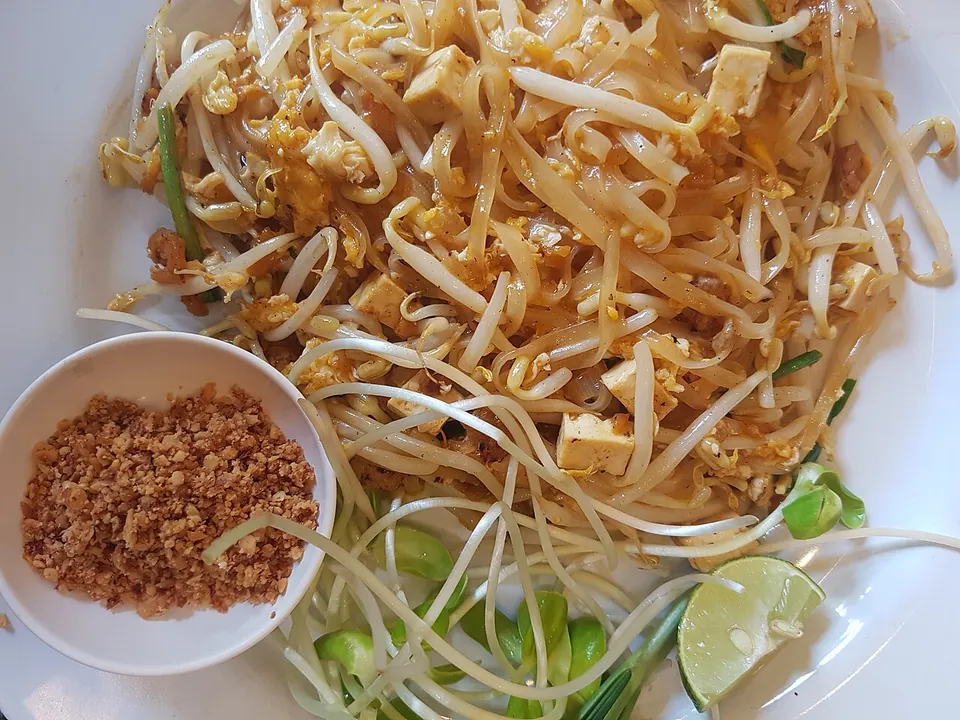
Pad Thai is a street dish of Thai rice noodles tossed in a wok. It reached its present form somewhere across a span that runs from the push for noodle-eating in the 1940s to the settling of the style in the 1960s. Just when it came together is still debated, and by how many decades remains an open question.
For this dish to exist, you first need the technique of frying rice noodles fast over a fierce flame. That stir-fry of rice noodles, known as kuaitiao, was carried in by Teochew Chinese immigrants and took root in Thailand between the nineteenth century and the 1920s. The very name pad Thai (ผัดไทย) means 'Thai-style stir-fry,' and so the dish's own name records how a foreign fried-noodle dish was remade into something Thai.
The sourness of tamarind, the salt of fish sauce, the rice noodles themselves: the ingredients were all long-established in the Thai kitchen. What made the dish new was the combination, binding these together with a stir-fry technique of Chinese origin and serving them cheaply from the street stall, a place open to everyone. Cooked to order on the spot and handed over fast, the economics of the stall carried the dish to a wide public.
How we know
About pad Thai there is one received story, repeated in travel guides and souvenir shops. In the eighteenth century, during the Ayutthaya kingdom, Chinese trading merchants brought over a fried-noodle dish, and it became pad Thai: an ancient Thai dish, so the tale goes.
Search the record, however, and nothing from the period supports it. The earliest appearance of the name pad Thai in writing is in a housewives' pamphlet of April 1962, and before that there is no record of a dish by that name. The dish's name carries the sense of 'Thai-style stir-fry,' and the frying technique kuaitiao is a loanword from Teochew; both point to a foreign dish that was made Thai. The record does not bear the ancient-origin tale out.
So when was it born? Here two views sit side by side. One is the making of a national dish under the government of Plaek Phibunsongkhram. When a flood in 1942 left rice in short supply, the government mounted a 'noodle is your lunch' campaign and handed out carts and recipes for the stalls. It was part of a cultural policy (the Ratthaniyom) to turn Chinese-style noodles into 'a Thai dish,' and peer-reviewed journals and food-history monographs have lately backed this policy origin.
The other view belongs to the historian Chatichai Muksong of Srinakharinwirot University. He argues that what the Phibun years promoted was 'fried noodles,' a different thing from today's pad Thai recipe, and taking the 1962 first appearance of the name as his evidence, he holds that pad Thai came together in the 1960s, in the era of globalization, as a marker of Thai food identity.
The two accounts remain hard to choose between, and the matter stays unsettled by a span of decades. What they do agree on is that the received story of an ancient Thai dish falls away. Pad Thai was not an old dish of the eighteenth century but a new one, shaped in the middle of the twentieth century amid the building of a nation-state.
The full set of origin theories and the detailed verification log — traceable all the way to their sources — are available on the Japanese edition.
See the full origin theories and verification log (Japanese) →