All dishes / 西欧
Haring (Dutch herring) Period BOrigin theory BVerified
Some fields (dish name, region and gates) are shown from the Japanese-edition data.
Willem Beukelszoon, the hero of the story that the Dutch created the salted herring called haring, may never have existed at all. The tale that he fathered the fish is a national fable that modern historians have set aside.
Verification highlight popular claim → verdict → evidence
No firm primary source survives for when gibbing (gutting and lightly salting herring) was established as a technique, or for the traditional account crediting a fisherman named Beukelszoon with inventing it; both the dating and the details still need further documentary verification.
The three gates
- Ingredient-supply gate
- North Sea herring was already a native ingredient; the dish depends on a preservation method of eating it raw or lightly salted (gibbing).
- Cooking-technique gate
- The technique is gibbing: removing the innards and lightly salting the fish.
- Venue gate
- It was street food sold at fishing-port markets and stalls.
Overview
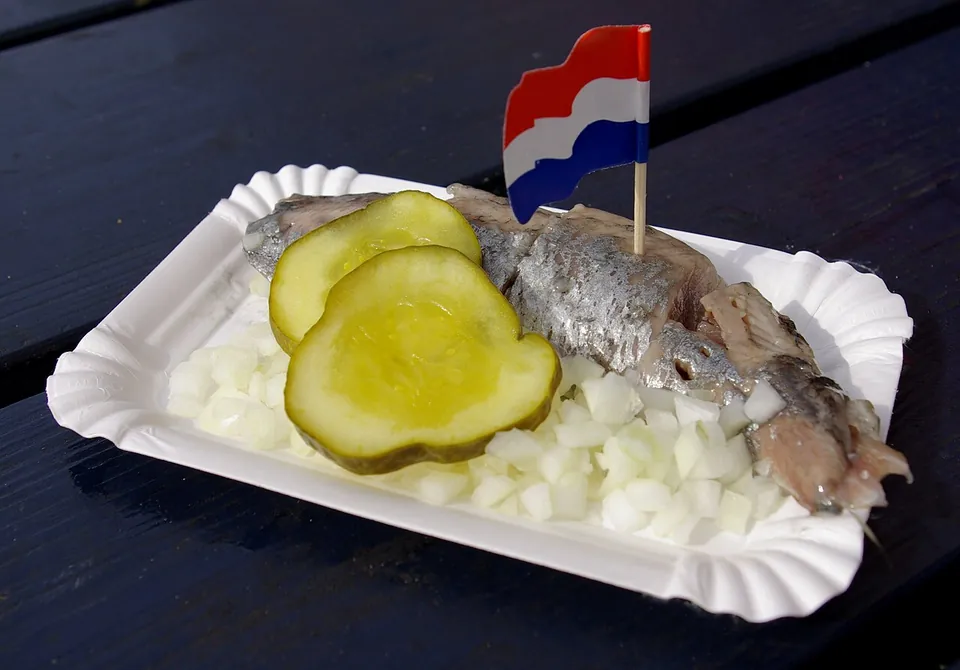
Haring is a Dutch market food: North Sea herring, gutted and lightly salted, eaten almost raw. Bolted down with onions at a harbor or a stall, it is still a symbol of Dutch eating.
The herring itself had long been caught in the North Sea. But to carry this perishable fish any distance, it had to be preserved the moment it was landed. That is what gibbing does, a quick treatment that removes only the gills and part of the gut and applies a light salting; it leaves the enzymes at work while holding off spoilage, and gives the fish its distinctive mellowness. Only once this treatment spread did haring become a product to set out at market.
What set the Dutch apart in the herring trade was that they could carry out this treatment not in a shore workshop but on the deck of a herring buss (haringbuis). Processed on the spot at the fishing grounds and packed into barrels, the ship could stay out at the distant grounds instead of running back to port. The first haringbuis is said to have been built around 1415 at Hoorn (De Vries and Van der Woude, The First Modern Economy, 1997). This system of processing and preserving aboard the ship underpinned the Dutch ascendancy of the fifteenth century.
How we know
The Dutch have long handed down a story like this. In the fourteenth century, a fisherman of Biervliet in Zeeland named Willem Beukelszoon invented the herring treatment around 1380, and it became the foundation of Dutch prosperity. His herring came to be called the King's herring, a source of national pride.
Follow the sources, though, and the story collapses under its own feet. Even the year of Beukelszoon's death cannot be fixed: 1347, 1380, 1397, 1401, the records disagree, to the point where a specialist encyclopedia writes that there is not even proof of his existence (Rigby's Encyclopaedia of the Herring). The notion that the treatment was created in Holland, and by a single man at that, has been set aside by modern historians (The Fishy History of Dutch Herring, The Low Countries).
In fact, the practice of gutting and lightly salting the fish was already being done as daily work by thousands of fishermen in fourteenth-century Scania (then Danish, now southern Sweden). The salted-herring trade of the Hanseatic League had carried it first. It was a shared craft, honed in many places, with no single inventor. The true Dutch achievement was to bring that craft aboard the ship and, at the distant grounds, do the processing and preserving in one. As a textbook case of a created tradition that traces an origin to a single hero, the shape of this anecdote is now plain to see.
The full set of origin theories and the detailed verification log — traceable all the way to their sources — are available on the Japanese edition.
See the full origin theories and verification log (Japanese) →