All dishes / 西欧
Wiener schnitzel Period BOrigin theory CVerified
Some fields (dish name, region and gates) are shown from the Japanese-edition data.
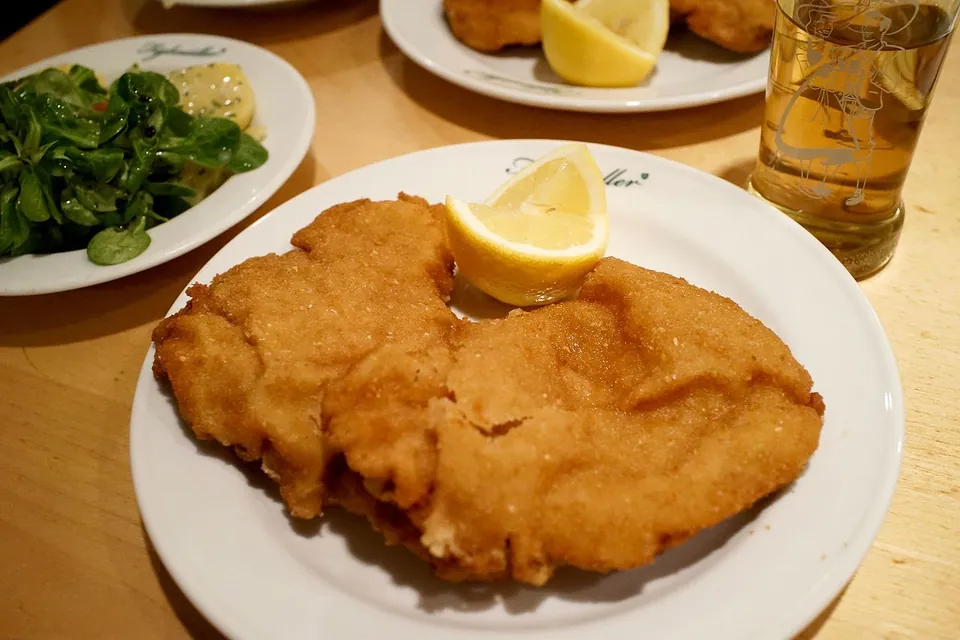
Vienna's signature veal cutlet. The well-known tale that "Field Marshal Radetzky brought the dish home from Milan" is a twentieth-century invention with no support in the historical record.
Verification highlight popular claim → verdict → evidence
The legend that General Radetzky brought the recipe home from Milan in 1857 is debunked by linguist Heinz-Dieter Pohl: the story first appears only around 1969, decades after schnitzel itself is already documented in an 1831 cookbook. The true origin is Austria's own native breaded-and-fried tradition (Backhendl, recorded as early as 1719), which developed in parallel with Milan's cotoletta rather than being derived from it -- though the exact 19th-century path to the modern veal schnitzel remains debated.
The three gates
- Ingredient-supply gate
- Veal and wheat are both native staples (their arrival dates are not limiting).
- Cooking-technique gate
- Breaded and pan-fried in the same technical lineage as Milan's cotoletta.
- Venue gate
- Middle-class dining out and home cooking.
Overview
When and where it took shape
Wiener schnitzel is an Austrian dish of Vienna: a thin-pounded veal cutlet dredged in flour and beaten egg, coated in breadcrumbs, and fried to a golden brown. As its name ("Viennese") says outright, it is a dish that took its shape at the tables of nineteenth-century Vienna. In the written record, the name appears plainly in Neudecker's cookbook, printed in Prague in 1831.
Both the veal at its heart and the wheat of its coating were ingredients long rooted in this land. In a Central Europe of ample stock-raising and grain-farming, both were everyday foods, ordinary in markets and farm kitchens alike.
And the method of coating in breadcrumbs and frying was already alive in Austria. Backhendl, chicken breaded and fried the same way, is recorded as early as 1719 in a Salzburg cookbook. It was in the nineteenth century that this veal schnitzel took shape under the name "Viennese" and put down roots in the city's dining out and home cooking.
Northern Italy has a close cousin: a veal cutlet breaded and fried in much the same way (cotoletta alla milanese). The two share the practice of breading and frying, kin to one another. Whether that closeness can be drawn as a single line of transmission, however, is another matter.
The Italian cousin
The Milanese cutlet and Wiener schnitzel share a technique, but sharing a technique is not the same as one descending from the other. Across Europe, breaded-and-fried meat belonged to a wide tradition, and both dishes grew within it. The kinship is real; the tidy story of a single hand carrying one over the Alps is what does not hold.
How we know
The tale of the general who brought it home
Wiener schnitzel comes with a well-known story of provenance. Field Marshal Radetzky, in 1857, is said to have carried the cutlet back to Vienna from Milan in northern Italy. A dish borne home by a general from the field makes a fittingly distinguished tale, easy to repeat.
Trace the story to its source, though, and the ground gives way. The earliest appearance of this transmission tale in print is Felice Cùnsolo's Italian gastronomic guide, published in Milan in 1969 — more than a century after the general's own day. The linguist Heinz-Dieter Pohl, in a study devoted to the word and history of schnitzel, dismisses the claim as having no source at all, with not a trace in Radetzky's own papers.
And, decisively, breaded-and-fried veal was in this land long before 1857, the year Radetzky is said to have returned from Milan. The 1719 Salzburg cookbook carries Backhendl, chicken fried by the same method — a record more than a century before the general's homecoming. The name of the dish itself is already there in an 1831 cookbook. Before any bringing home, schnitzel was in Vienna.
So what is the real provenance? The historian Ingrid Haslinger, tracing three centuries of Viennese cookbooks, places schnitzel within the city's stream of citizens' cooking. Sharing a technique with its Milanese cousin, Wiener schnitzel nonetheless grew up here, out of the breaded-and-fried tradition alive across Europe — that is the measured view today. The general's feat was decoration added after the fact.
The full set of origin theories and the detailed verification log — traceable all the way to their sources — are available on the Japanese edition.
See the full origin theories and verification log (Japanese) →